
Waterbury Criminal Court Records
A Waterbury City criminal court record is the official court case record kept after charges are filed in Superior Court. It can include the defendant name, docket number, court location, charging information, arraignment events, pleas, motions, continuances, orders, trial or plea activity, disposition, sentence, bond conditions, and related warrants. For a closer look at the charge itself, use court charge records after arrest. For broader civil, family, housing, and probate material, use all Waterbury court records.
Waterbury criminal and motor vehicle matters are tied to Connecticut Superior Court, not a county court. Criminal Judicial District and Geographical Area #4 operations are listed at 400 Grand Street. The Waterbury Judicial District State's Attorney prosecutes criminal offenses in the district, and the public defender office at the same courthouse serves qualifying defendants. Jail custody status is separate from the court case file, so an inmate lookup can show location while the criminal court record shows the prosecution.
The pending criminal search source in the manifest is the Judicial Branch pending criminal and motor vehicle case search by defendant.
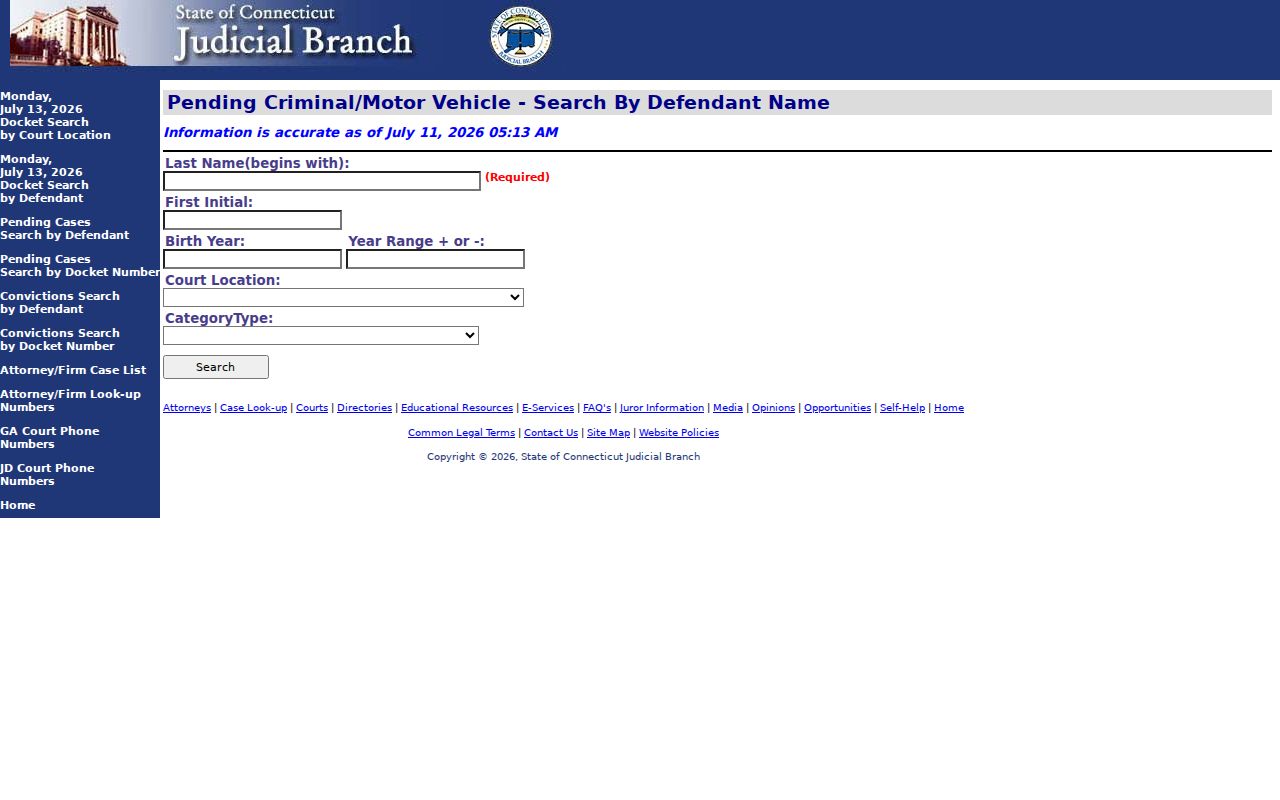
This pending-case search is the main online starting point when a Waterbury criminal case is open and tied to a defendant name.
Search Waterbury Criminal Cases
The Connecticut criminal and motor vehicle case menu separates pending cases, conviction searches, daily dockets, docket-number searches, attorney or firm lookup, and warrant search. Pending case search is useful for active prosecutions. Conviction search is useful for disposed cases that remain displayable under Judicial Branch rules. Daily docket search is useful for finding hearings scheduled by court or defendant.
- Open the Judicial Branch criminal and motor vehicle case menu.
- Choose pending case search for an active Waterbury criminal matter or conviction search for a disposed conviction record.
- Search by defendant name, or use docket-number search when court papers list the docket.
- Check daily docket tools for court dates, hearing location, and calendar activity.
- Contact the Waterbury criminal clerk for certified copies, sealed-file questions, older records, or document access not shown online.
The Judicial Branch conviction search source is the criminal conviction search by defendant.
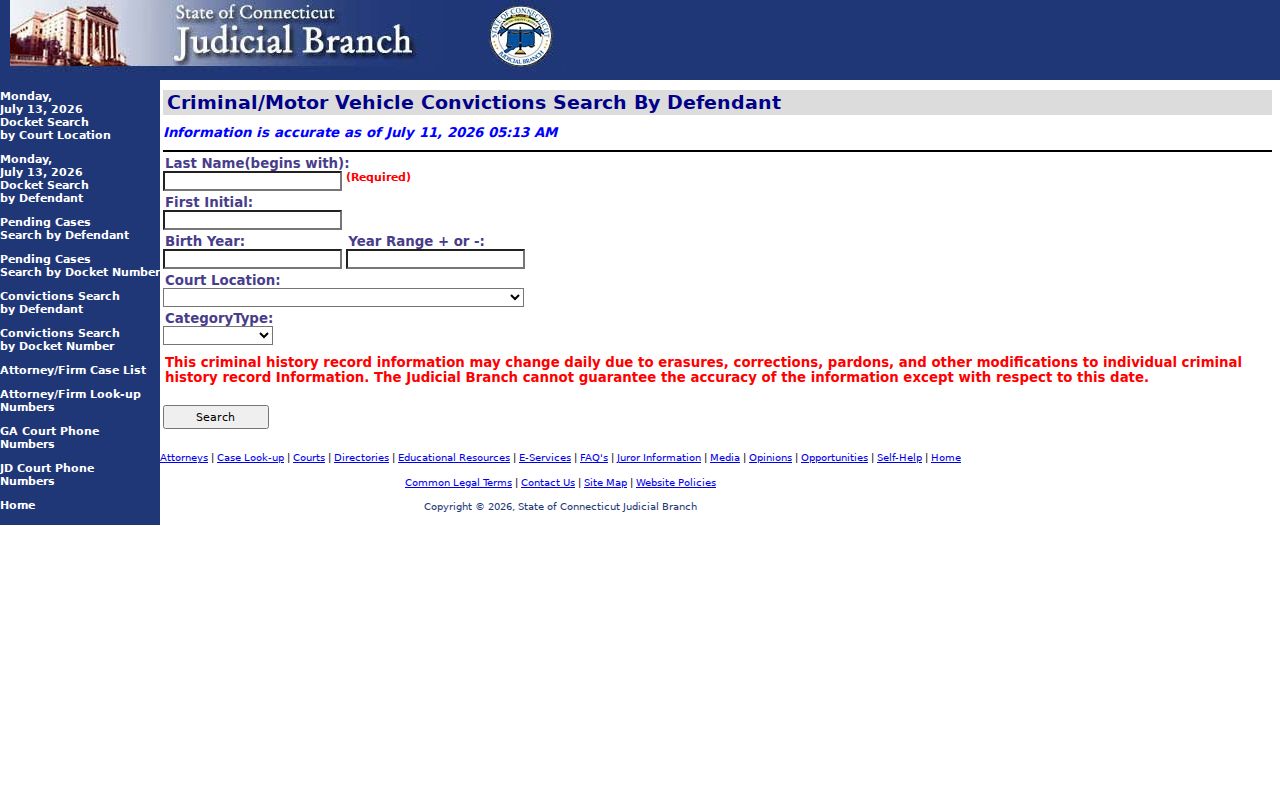
Conviction search should be read with the Judicial Branch retention notice because older or restricted conviction information may not display.
Waterbury Criminal Case Flow
A criminal case file changes as the prosecution moves through court. The court record starts with charges as filed, then adds arraignment events, release or bond conditions, motions, continuances, pleas, trial activity, disposition, and sentence. The same person may also have separate police records, custody records, and warrant records, but those are not the same as the Superior Court criminal case file.
Case flow: Charges Filed › Arraignment › Pretrial / Motions › Plea or Trial › Disposition › Sentencing
| Stage | What Happens |
|---|---|
| Charges filed | The prosecution begins the court case and the docket tracks the filed charge or charges. |
| Arraignment | The defendant first appears in court, and release, bond, protective orders, or next dates may be addressed. |
| Pretrial and motions | The docket may show continuances, discovery disputes, suppression motions, conferences, and court orders. |
| Plea or trial | The case may resolve by plea or proceed to trial, verdict, dismissal, or acquittal. |
| Disposition and sentencing | The record shows the outcome and sentence when the result is public and not erased or sealed. |
What Criminal Records Show
Waterbury City criminal court records should be read field by field. A pending case may show the accusation and next court event but not a final outcome. A disposed case may show a conviction, dismissal, nolle, acquittal, sentence, or other result. A warrant, bond condition, mittimus, probation violation, or protective order may appear in relation to the criminal case when public.
| Field | What It Shows |
|---|---|
| Docket number | The criminal or motor vehicle case identifier used by Connecticut courts. |
| Defendant | The person accused in the Superior Court case. |
| Court location | Waterbury JD, Waterbury GA 4, Waterbury Community Court, or another assigned location. |
| Charges | The filed accusations, statute references, severity, and amendments where public. |
| Plea | The defendant's formal response or plea agreement activity when entered on the record. |
| Events | Arraignment, hearings, continuances, motions, orders, trial settings, or daily docket entries. |
| Disposition | The outcome of each charge or case, such as conviction, dismissal, nolle, acquittal, or other result. |
| Sentence | Jail, probation, fine, restitution, suspended sentence, or other court-ordered penalty where public. |
Note: A criminal charge is an accusation until a plea, verdict, dismissal, or other disposition changes its status.
Charges vs Convictions
Waterbury City criminal court records can show charges that never become convictions. A charge may be dismissed, nolled, amended, reduced, merged, or resolved by acquittal. A conviction means guilt was entered by plea or found by verdict and the court imposed or recorded an outcome. This distinction is central when reading criminal case files, court charge records, and background search results.
| Point | Charge | Conviction |
|---|---|---|
| Meaning | An accusation filed in court. | A guilty plea, verdict, or other finding of guilt. |
| Timing | Appears early in the case. | Appears after disposition. |
| Record risk | May later be dropped, dismissed, nolled, or erased. | May still be limited by retention, erasure, pardon, or sealing rules. |
| Where to check | Pending case search, daily docket, and charging records. | Conviction search and final case disposition. |
The Waterbury prosecutor source in the manifest is the Waterbury Judicial District State's Attorney profile.
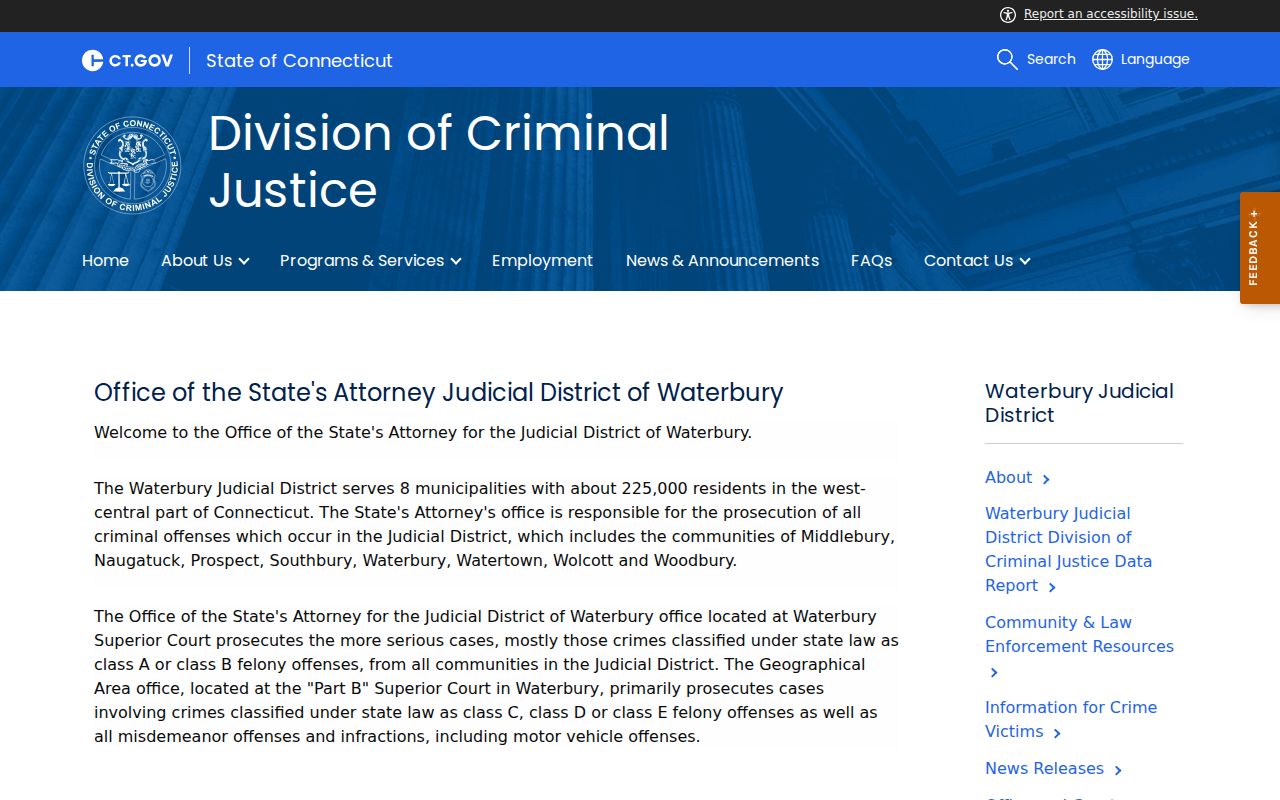
The State's Attorney's Office prosecutes Waterbury criminal matters, but the public criminal court record remains a court record handled through the Judicial Branch and clerk.
Dispositions and Sentences
A disposition is the result of a charge or case. In Waterbury criminal court records, a disposition may show guilty, not guilty, dismissed, nolled, acquitted, or another outcome. Sentencing information may include jail, probation, fines, restitution, a suspended sentence, or conditions. A probation violation can create new court events and may also connect to warrant records when a failure to appear or violation warrant is issued.
The Judicial Branch warns that criminal history information may change daily due to erasures, corrections, pardons, and modifications. Conviction information is generally shown for no more than 10 years after sentencing unless Practice Book Section 7-13 provides a shorter period. Youthful offender cases, juvenile cases, and infraction or violation convictions are not shown in the public conviction display.
Sealed and Erased Records
Connecticut uses erasure language for many criminal-record outcomes. Under C.G.S. 54-142a, certain dismissed, nolled, acquitted, pardoned, decriminalized, or otherwise eligible matters may be erased. A sealed record is hidden from public access by law or court order. Both can affect what appears in a Waterbury City criminal court records search.
| Point | Sealed | Erased |
|---|---|---|
| Public visibility | Closed from public view unless access is authorized. | Treated under Connecticut erasure law rather than as an ordinary public record. |
| Common source | Court order, statute, juvenile rule, or confidential case type. | Dismissal, nolle, acquittal, pardon, or other statutory basis. |
| How to review | Usually requires court authority or a statutory right. | Public access is limited once erasure applies. |
| Search effect | The case or document may be hidden or redacted. | The case may disappear from public criminal search results. |
The erasure source image comes from Connecticut's criminal erasure statute.
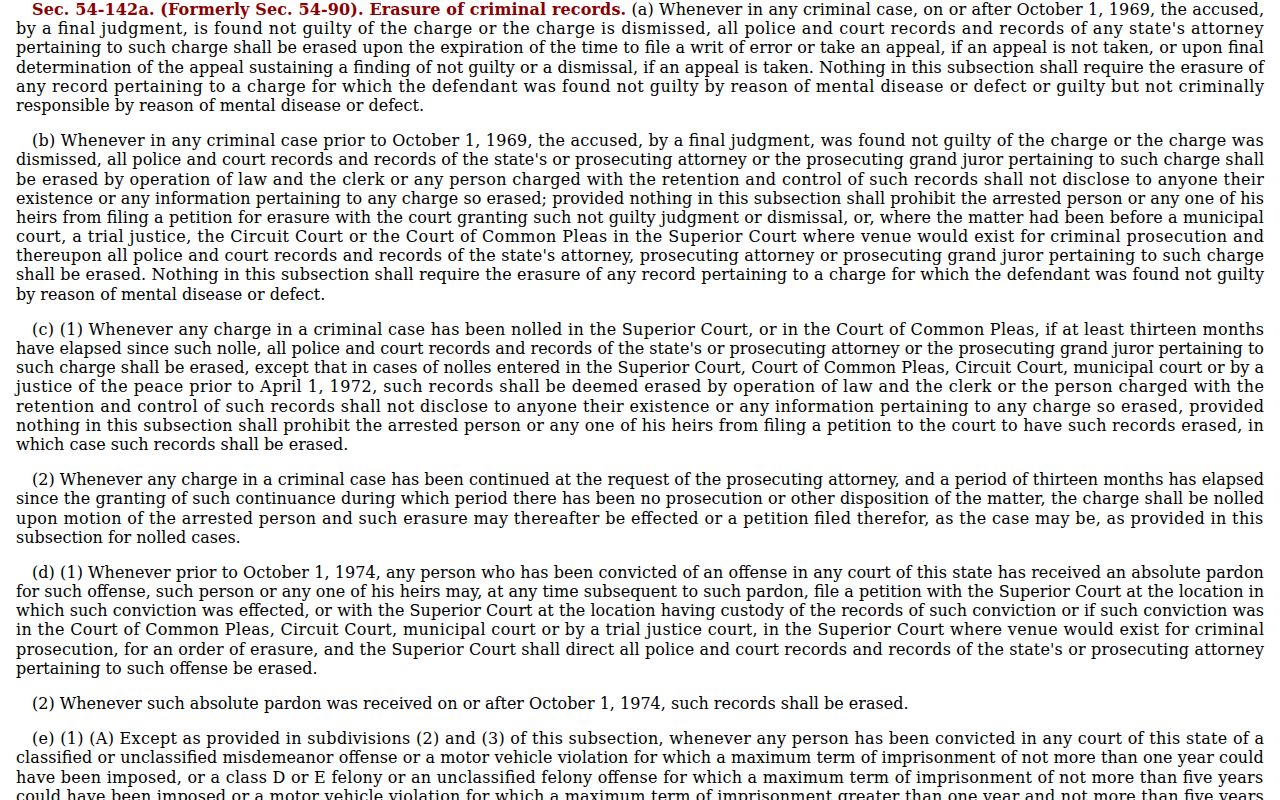
Erasure is one reason an old Waterbury criminal matter may not appear even if a third-party site still shows stale information.
Public Criminal Record Access
Waterbury criminal court records are public only to the extent allowed by Connecticut court rules, statutes, and case orders. General public records law appears in C.G.S. 1-210, but court files also follow Judicial Branch access rules and criminal-specific limits. The Judicial Branch public access materials should be used for court-record access questions, while city police reports may go through Waterbury Police Records or GovQA.
Key Statutes:
C.G.S. 54-142a addresses erasure of eligible criminal record information.
C.G.S. 54-76l makes youthful offender records confidential.
C.G.S. 46b-124 restricts juvenile matter records.
Prosecutor and Defender Offices
Connecticut does not use county district attorneys. The prosecutor for the Waterbury Judicial District is the State's Attorney. The official Division of Criminal Justice materials identify Maureen Platt as Waterbury State's Attorney and describe the Waterbury Judicial District as serving Waterbury plus Middlebury, Naugatuck, Prospect, Southbury, Watertown, Wolcott, and Woodbury. Prosecutors file and resolve charges, but public access to the court record still runs through the Judicial Branch and clerk.
Public Defender Services has a Waterbury Judicial District office at 400 Grand Street. The official Waterbury J.D. / G.A. #4 public defender page lists the J.D. phone as (203) 236-8188 and the G.A. #4 phone as (203) 236-8170. Public defenders represent qualifying defendants. They are not a public-records office and should not be used as a substitute for clerk record requests.
The public defender source image comes from the Public Defender Services judicial district office list.
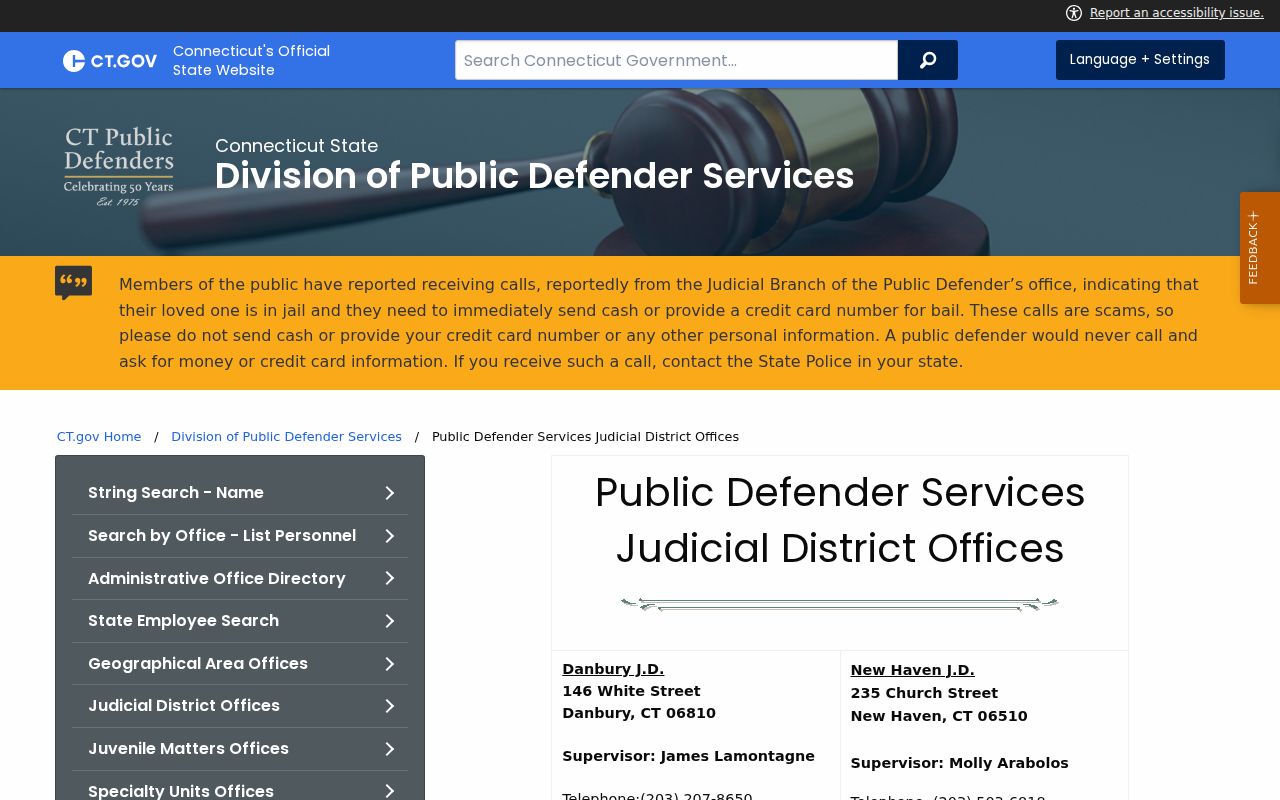
That office detail helps separate representation questions from the court clerk's role in maintaining Waterbury criminal case records.
Restricted Waterbury Criminal Records
Juvenile cases, youthful offender records, erased matters, sealed files, protected victim information, sealed warrant affidavits, and some mental health or family-related materials may be restricted. A criminal court record can also have redactions for Social Security numbers, financial account data, protected addresses, and minor information. The public portal may show less than the courthouse file, and the courthouse file may still be partly closed to the public.
For custody status after a Waterbury arrest, use inmate records. For active failure-to-appear, violation-of-probation, or order-to-incarcerate questions, use warrant records. For the criminal court case itself, keep the focus on the docket, filed charges, hearings, disposition, and sentence. A record that is missing from a public search is not proof that no case ever existed.
The statewide State's Attorneys directory is another criminal-justice source in the manifest at Connecticut State's Attorneys.
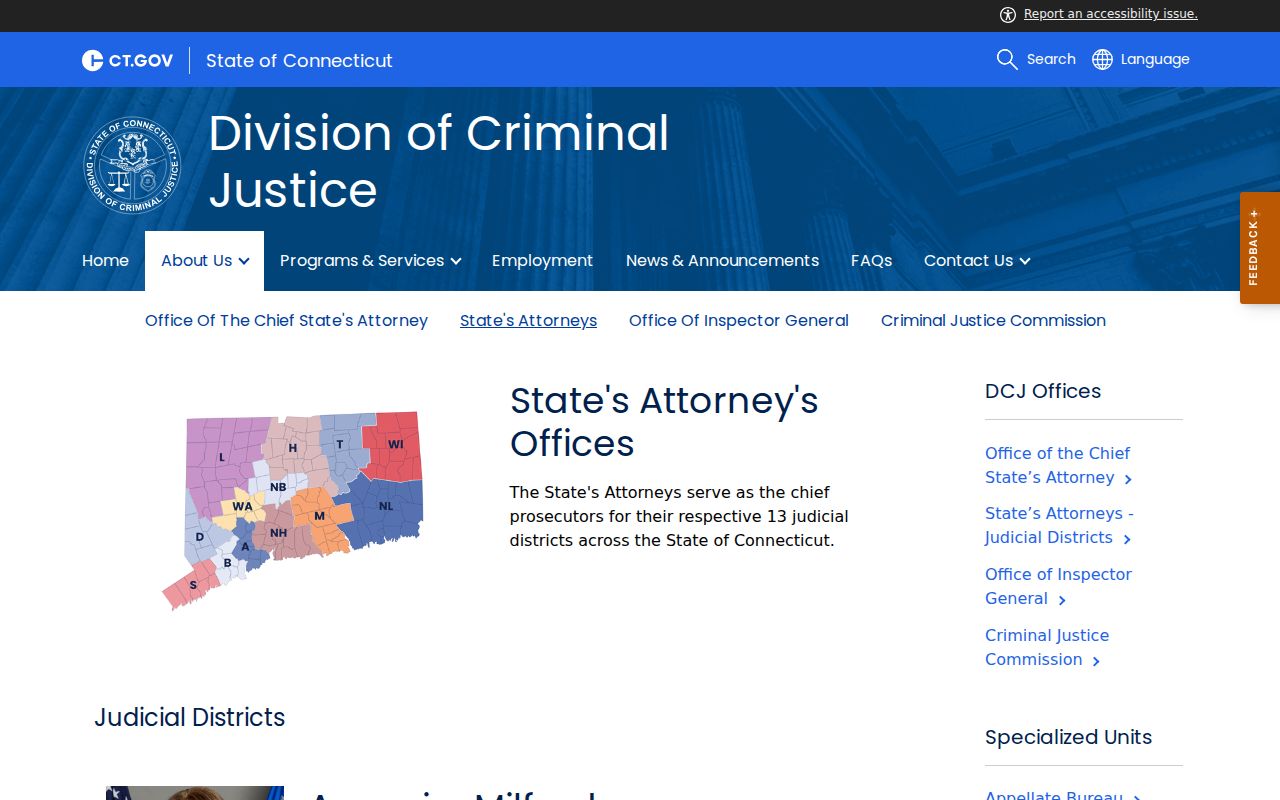
The directory confirms the prosecutor structure, while record access still depends on Judicial Branch portals, the Waterbury clerk, and confidentiality law.