
Waterbury City Arrest Records and Charges
Arrest records and court charge records are related, but they are not the same file. A Waterbury arrest may create police records, booking information, and custody data. Once the prosecution begins, the official court charge record appears through Connecticut Judicial Branch criminal and motor-vehicle case tools. That court record may show the defendant, docket number, charge, court location, hearing date, disposition, and public conviction information where allowed.
Connecticut prosecutors are State's Attorneys, not county district attorneys. The Waterbury Judicial District State's Attorney is Maureen Platt, and the official Division of Criminal Justice profile describes the Waterbury State's Attorney as the chief law enforcement officer for the Waterbury Judicial District. That district covers Waterbury and surrounding towns, so a charge filed in Waterbury court may involve a person or incident from another nearby municipality.
The Connecticut DOC inmate information page is one official custody source for Waterbury City arrest records when a person has moved into state correctional custody.
The DOC inmate information page explains the limits of custody data.
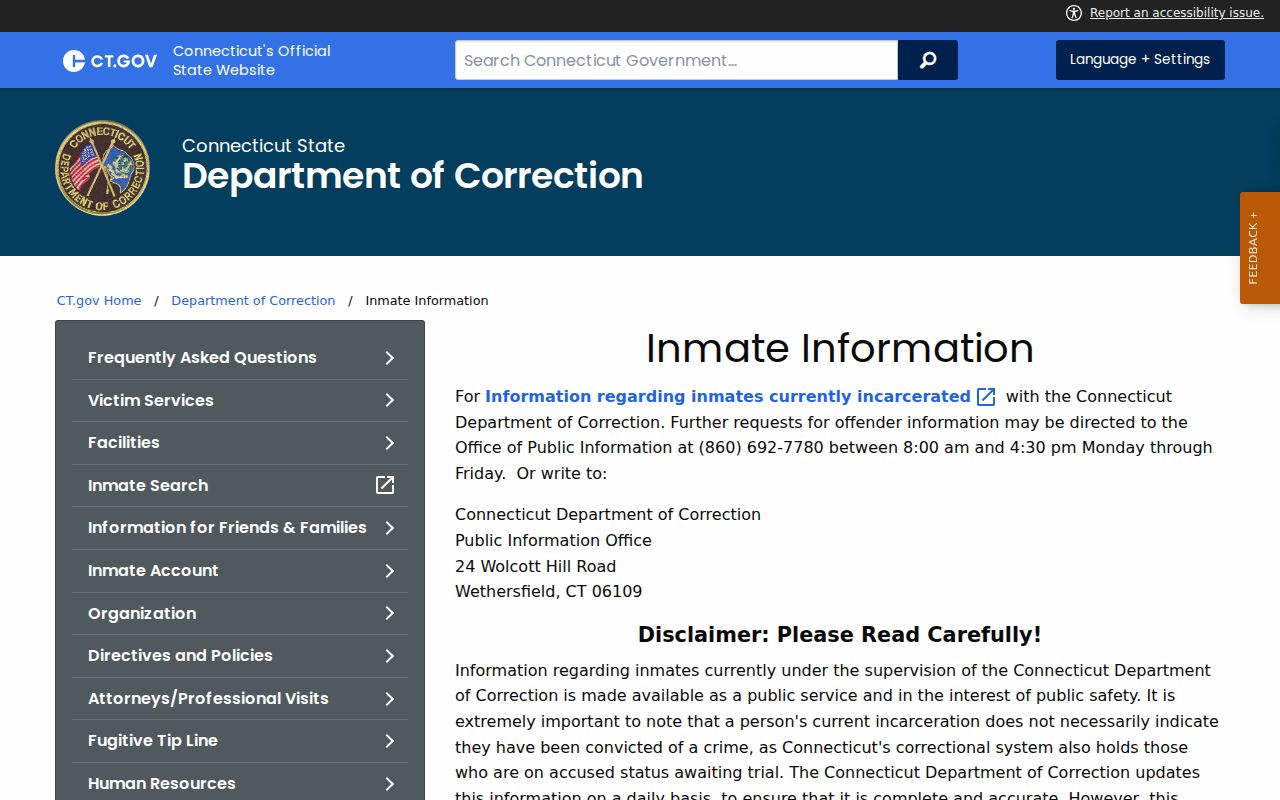
That warning is important because custody status does not prove guilt and can include accused-status pretrial detainees.
Search Waterbury Arrest Records and Charges
The best first stop for court charges after arrest is the Judicial Branch criminal and motor-vehicle case lookup menu. Use pending case search by defendant for active matters, conviction search for public conviction records, daily docket search for scheduled appearances, and docket-number search when court papers list the docket. Arrest and incident reports are requested through Waterbury Police or the city GovQA portal, while custody status comes from Connecticut DOC.
- Open the Judicial Branch criminal and motor-vehicle case menu.
- Search pending cases by defendant name, or use a docket number from court papers.
- Check the daily docket by court if the issue is a new arraignment or missed court date.
- Review each public charge, court location, disposition, and next event.
- Use DOC inmate lookup for custody location and Waterbury Police records for arrest-report requests.
For booking and custody detail after a Waterbury arrest, use the Waterbury City inmate records page. For the full criminal case file, including pleas, motions, disposition, and sentence, use Waterbury City criminal court records.
Charges Filed After Arrest
After an arrest, the charge record begins when the prosecutor files or proceeds on formal accusations in court. Connecticut research for Waterbury did not identify a county grand-jury style public charge portal; the practical public route is the state criminal/motor-vehicle pending case search, conviction search, and daily docket. One arrest can lead to one charge, several charges, amended charges, or no displayable public conviction.
| Document Type | Who Uses It | Waterbury Context |
|---|---|---|
| Complaint | Police or prosecution | May be reflected in an initial criminal or motor-vehicle case after arrest. |
| Information | State's Attorney | Formal prosecution document for many Connecticut criminal charges. |
| Indictment | Federal grand jury or special process | Usually a federal District of Connecticut issue, not the Waterbury state portal. |
Waterbury Charge Status Terms
Charge status can change as a case moves from arraignment to pretrial, plea, trial, or dismissal. A pending charge is an accusation. It can be amended, reduced, nolled, dismissed, or end in conviction. The Judicial Branch warns that criminal history information can change daily due to erasures, corrections, pardons, and modifications.
| Status | What It Means |
|---|---|
| Pending | The charge is open and has not reached a final public outcome. |
| Amended or Reduced | The prosecution changed the charge, severity, or statutory basis. |
| Dismissed | The court ended the charge without a conviction. |
| Nolle Prosequi | The prosecutor declined to continue the charge, often called a nolle. |
| Conviction | A guilty finding or plea that remains displayable under Judicial Branch rules. |
Charges vs Convictions
A Waterbury charge is an accusation filed in court. A conviction is the result of a guilty plea, guilty finding, or other outcome that legally establishes guilt. The public conviction search is narrower than the pending case search. The Judicial Branch states conviction information is generally shown for no more than 10 years after sentencing unless Practice Book Section 7-13 provides a shorter period, and it excludes youthful offender cases, juvenile cases, infractions, and violation convictions.
| Point | Charge | Conviction |
|---|---|---|
| Meaning | Formal accusation after arrest or summons. | Final guilt outcome by plea or finding. |
| Where to Search | Pending criminal/motor-vehicle case lookup and daily docket. | Conviction search when the record remains displayable. |
| Limits | May later be dropped, amended, nolled, or sealed. | May be erased, pardoned, corrected, or no longer publicly displayed. |
Police Reports and GovQA Requests
Police records are not the court charge record. Waterbury Police may hold incident reports, arrest reports, and records created before or during booking. The research lists Waterbury Police Records Division questions at (203) 574-6933 and states that official city pages direct public-records requests to GovQA for many city records. Court charges, however, should be verified through Judicial Branch systems or the Superior Court criminal clerk.
Waterbury's official GovQA public-records request portal is the city channel for municipal records requests.
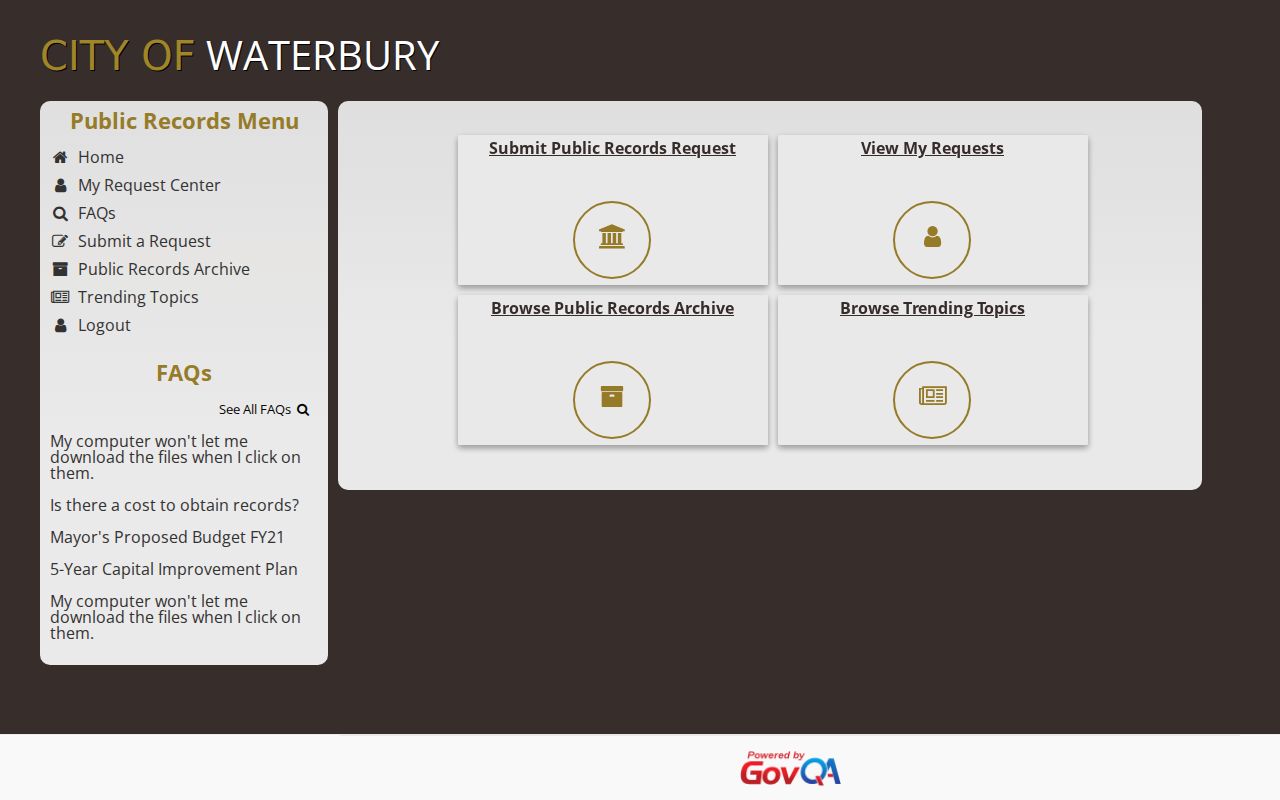
Use GovQA or Police Records for city police documents, but use court lookup for charges filed in the prosecution.
State's Attorney and Defense Contacts
The State's Attorney reviews and prosecutes Waterbury Judicial District criminal cases. The Waterbury Judicial District State's Attorney page names Maureen Platt and describes the district as serving Waterbury, Middlebury, Naugatuck, Prospect, Southbury, Watertown, Wolcott, and Woodbury. A public defender is not a records office, but the Waterbury J.D. and G.A. #4 public defender contacts matter when a person needs legal help after arrest.
Waterbury Public Defender
400 Grand Street
Waterbury, CT 06702
(203) 236-8188
G.A. #4 line: (203) 236-8170
Waterbury Criminal Clerk
400 Grand Street
Waterbury, CT 06702
(203) 236-8100
Criminal and motor-vehicle case questions
Erased and Sealed Charges
Connecticut uses erasure language for many criminal record outcomes. Under C.G.S. 54-142a, eligible dismissed, nolled, acquitted, pardoned, or otherwise qualifying matters may be erased from public access. A sealed record is closed from public view by law or court order, while an erased record is treated under the Connecticut erasure statute rather than as an ordinary public record.
| Record Limit | Public Effect | Waterbury Search Impact |
|---|---|---|
| Sealed | Hidden unless law or court order allows access. | May not appear in ordinary case lookup or may show limited docket data. |
| Erased | Treated under Connecticut erasure law. | Public criminal history can change after erasure, pardon, correction, or modification. |
| Youthful offender | Confidential under C.G.S. 54-76l. | Not shown in the public conviction lookup. |
| Juvenile | Restricted under C.G.S. 46b-124. | Not displayed like adult criminal matters. |
Background Check Considerations
Casual court lookup is not the same as a regulated background check. A court charge search can miss sealed, erased, juvenile, youthful offender, federal, or recently changed data. It can also show pending accusations that never become convictions. Use official court and agency sources for verification, and do not use public lookup results for FCRA-regulated decisions unless the process complies with applicable law.
Important: Public charge lookups do not replace official criminal-history procedures or FCRA-compliant screening.
Restricted Waterbury Charge Records
Restricted charge records include juvenile matters, youthful offender cases, sealed files, erased matters, protected-address information, and records that would expose active investigations. Police narratives, witness statements, sealed warrant affidavits, and full charging documents may also be unavailable through public portals. If a public search returns no result, it may mean the matter is not public, not yet entered, in a different system, or recorded under a docket or spelling that the search did not match.
The Connecticut youthful offender confidentiality statute is one of the main limits on public charge records.
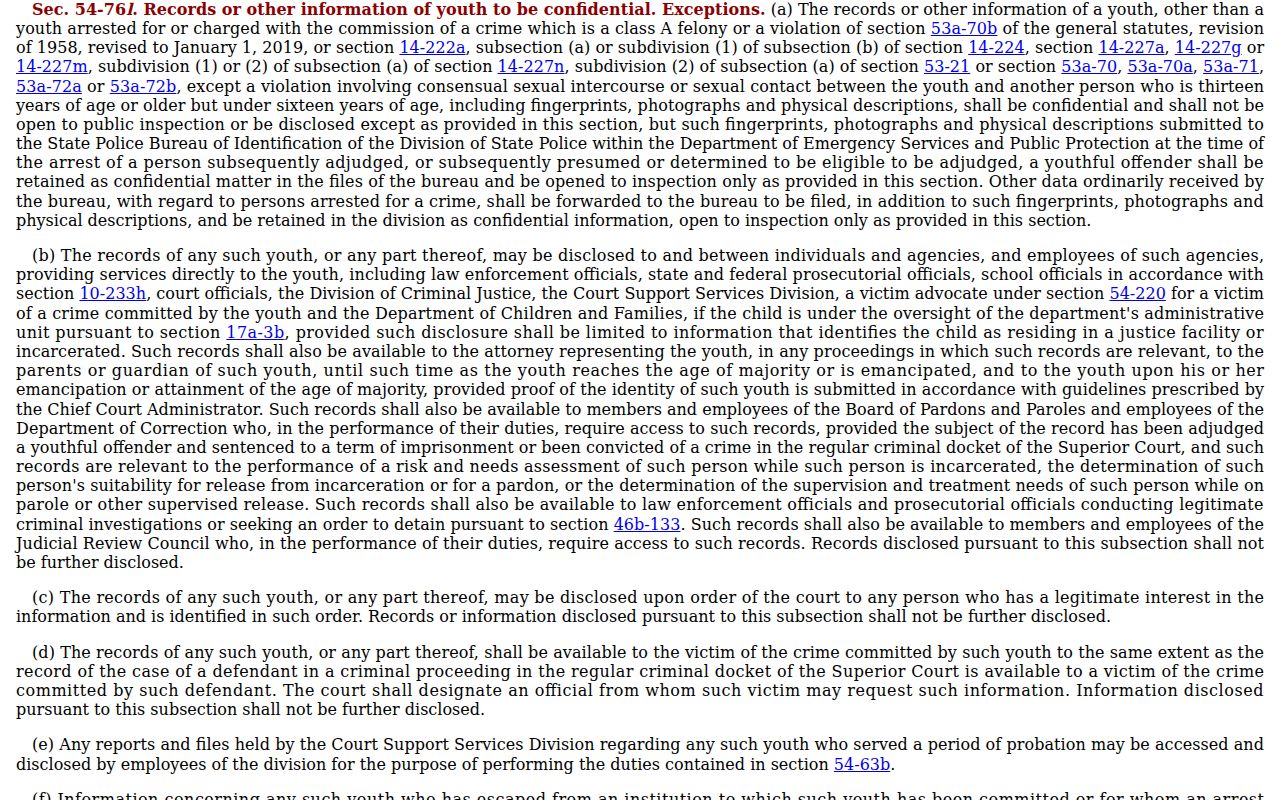
That restriction explains why some arrest-to-charge events will not appear in public criminal conviction searches.
Public Record Search
Sponsored Results