
Search Waterbury Court Records
Most Waterbury City court records start at the Connecticut Judicial Branch case look-up menu. That menu routes users to appellate, civil, family, criminal, motor vehicle, housing, and small claims systems. Civil, family, housing, foreclosure, judgment, and small claims matters use the Superior Court civil inquiry portal. Criminal and motor vehicle cases use the Judicial Branch criminal menu, which separates pending cases, convictions, daily dockets, attorney lookup, and warrant search.
Waterbury has several useful location cues. Civil and family matters commonly use UWY-Waterbury JD. Housing matters may use WTH-Waterbury Housing Session. Criminal and motor vehicle court matters may be tied to Waterbury GA 4, Waterbury JD, or Waterbury Community Court. A city parking ticket, police incident report, or marriage certificate is not searched the same way. Those records route to Waterbury municipal offices, the Police Records Division, or Vital Statistics.
- Choose the portal by record type, starting with civil inquiry for civil, family, housing, foreclosure, and small claims cases.
- Use party-name search when the legal spelling is known, and narrow by Waterbury location or case type if the portal offers those fields.
- Use docket-number search when a summons, order, notice, appearance form, or prior record lists the docket number.
- For criminal or motor vehicle cases, use the Judicial Branch criminal menu for pending cases, convictions, daily dockets, or docket-number lookup.
- Contact the correct Waterbury Superior Court clerk when the online court record does not show documents, certified copies, sealed items, or older paper files.
The Superior Court party-name search screen shows the Waterbury court-record search fields most users need first.
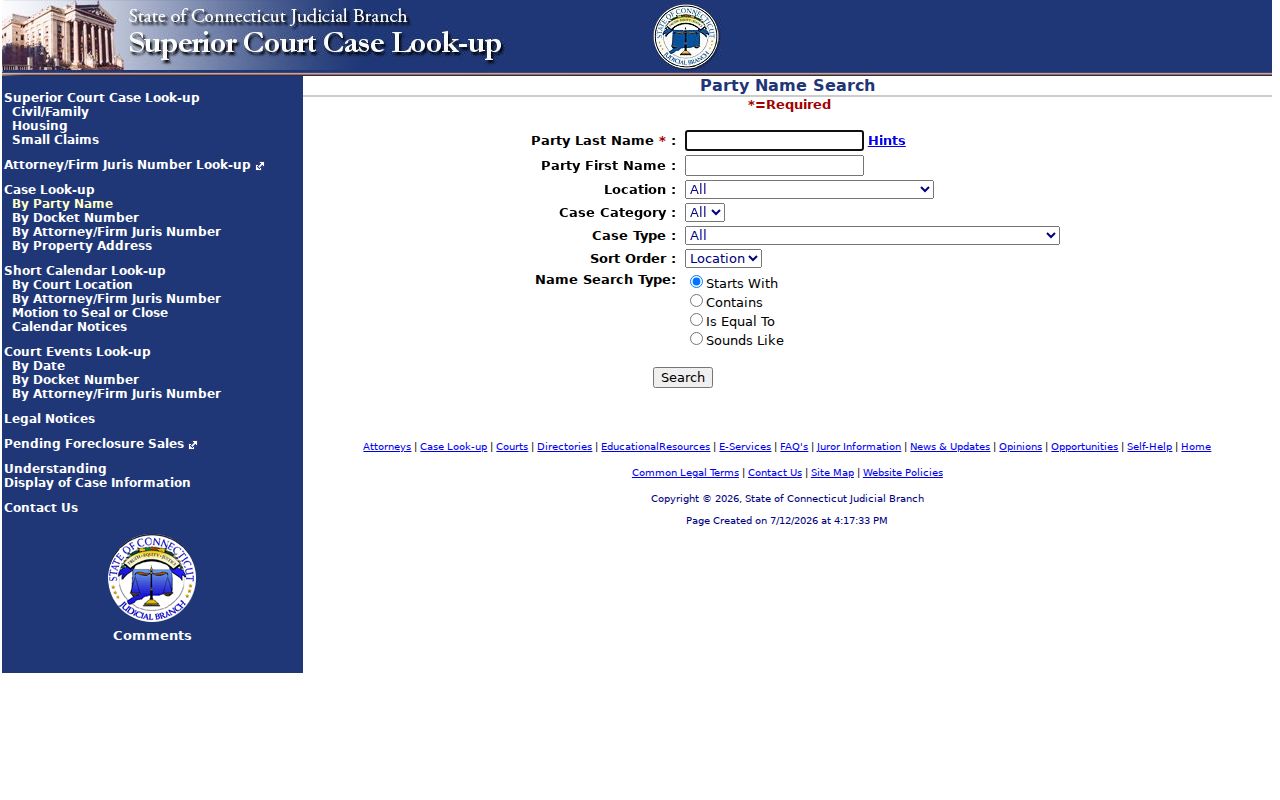
This search view is useful when a Waterbury court record is known by party name but the docket number is not available.
Waterbury Court Records Search Fields
The civil inquiry portal supports broad and narrow searches. The name search fields help locate a case by party. The location and case-type fields keep Waterbury City court records from being mixed with unrelated statewide results. The docket-number search is stricter, but it is often the best path when court papers list a docket code and number.
| Field Label | Type | Required | Notes / Format |
|---|---|---|---|
| Party Last Name | Text | Yes | Maximum length 54; use the legal spelling where possible. |
| Party First Name | Text | No | Helps narrow common names in Waterbury and statewide results. |
| Location | Dropdown | No | Includes UWY-Waterbury JD, WTH-Waterbury Housing Session, and 650-Waterbury-UF. |
| Case Category | Dropdown | No | Filters broad groups such as civil, family, housing, and small claims. |
| Case Type | Dropdown | No | Includes divorce, custody, foreclosure, housing, small claims, probate appeals, wills, and trusts. |
| Name Search Type | Radio | No | Starts With, Contains, Is Equal To, or Sounds Like. |
| Full Docket Number | Text | Alternative | Use the full location code, year, and case number when known. |
The Superior Court docket-number search shows how Connecticut splits a docket into location, year, and number parts.
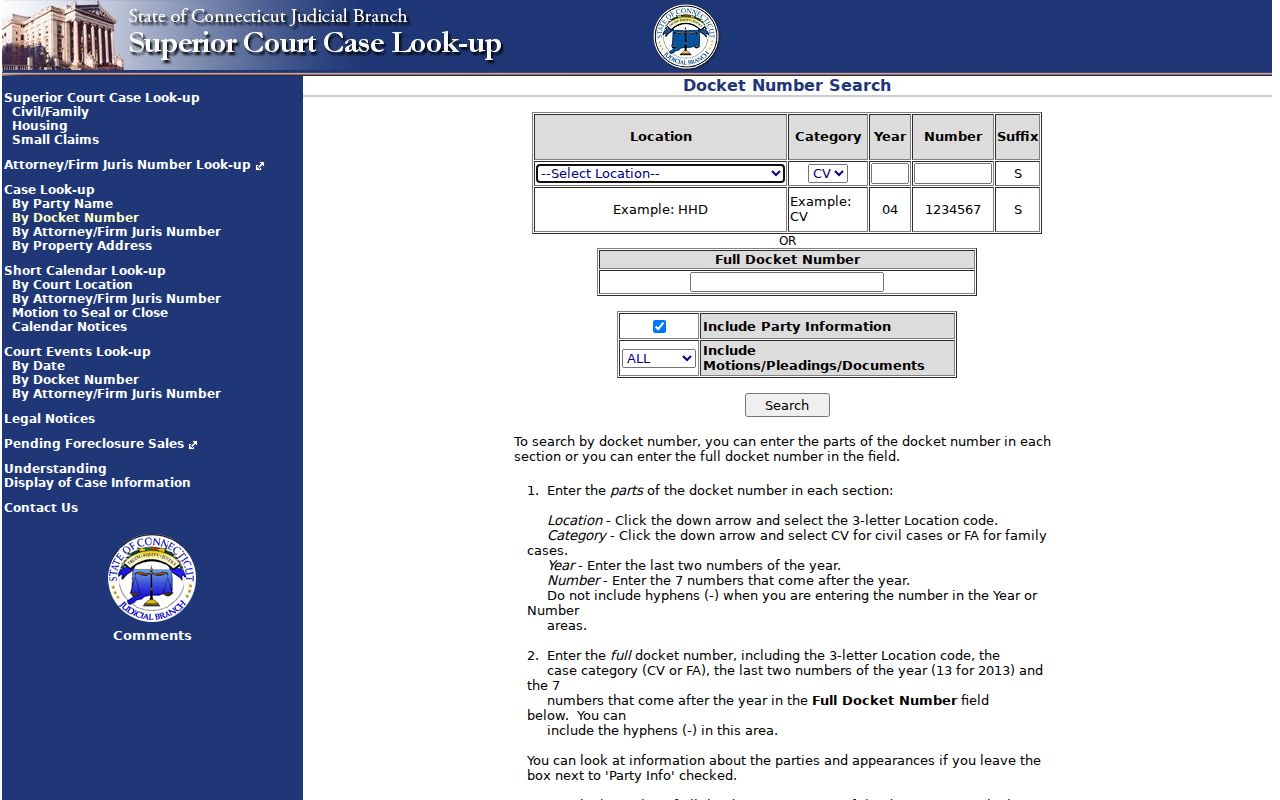
That format matters because a docket-number search can miss a Waterbury court record if the location code or seven-digit number is entered incorrectly.
Types of Waterbury Court Records
Waterbury City court records are not kept in one local county database. The Superior Court record set includes civil complaints, appearances, motions, orders, judgments, executions, foreclosure items, family cases, housing matters, small claims, criminal case files, motor vehicle cases that require court, and certain calendars. Probate records use Connecticut Probate Court systems, while city parking tickets and police reports use Waterbury municipal channels.
For a broad court-record search, start with the case category. Civil and family records often show party names, docket numbers, case types, appearances, motions, orders, judgments, and short-calendar events. Criminal records show defendant information, charges, pleas, dispositions, sentences, bond conditions, continuances, warrants, and court dates where public. Housing records may show summary process, rent, damages, security deposit, and code-related case types. Probate records are separate and should be searched through Connecticut Probate Courts.
- Civil records cover lawsuits, contracts, collections, torts, foreclosure, property matters, and judgments.
- Family records cover divorce, legal separation, annulment, custody, support, parentage, visitation, and relief from abuse.
- Criminal and motor vehicle court records cover charges, arraignment, pleas, hearings, disposition, sentencing, and court-required motor vehicle cases.
- Housing and small claims records cover summary process, rent disputes, security deposits, small debts, and related case types.
- Probate records cover estates, trusts, guardianship, conservatorship, and some children's matters in a separate court system.
The U.S. District Court for the District of Connecticut is a different system from Waterbury Superior Court.
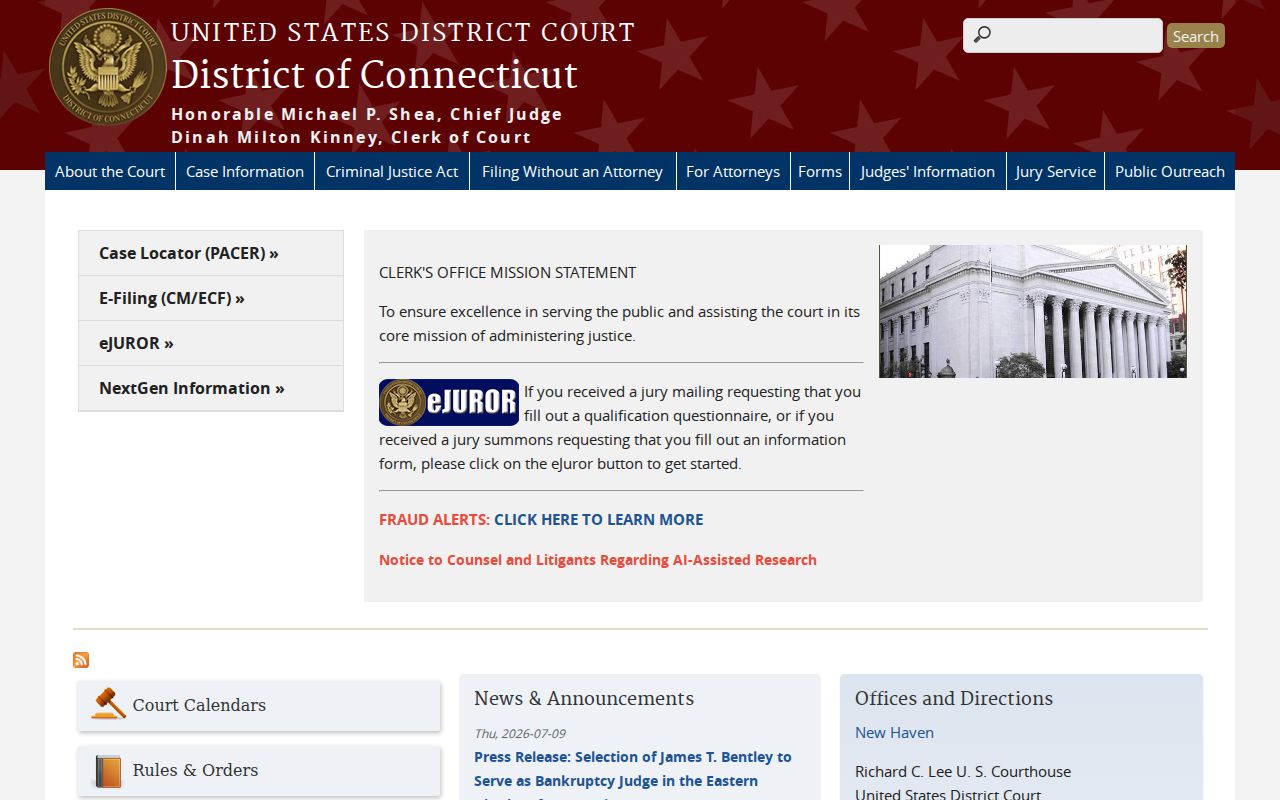
Federal civil, criminal, bankruptcy, and appeal records are searched through federal court systems, not the Connecticut Judicial Branch civil inquiry portal.
What Waterbury Court Records Show
A Waterbury City court record is a structured case record, not just a name result. The exact fields depend on the case type and access rules. A civil case may show parties, filings, motions, court events, short-calendar activity, judgments, and foreclosure sale notices. A criminal case may show defendant name, docket number, charge, public disposition, sentencing date, and daily docket details. Restricted fields may be removed or hidden before a public display appears.
| Field | What It Shows |
|---|---|
| Docket number | The court location code, year, and case number used to identify the record. |
| Court location | Waterbury JD, Waterbury Housing Session, Waterbury GA 4, Waterbury Community Court, or another statewide location. |
| Parties | Plaintiff, defendant, petitioner, respondent, applicant, state, or accused person. |
| Case type | The legal category, such as divorce, custody, foreclosure, small claims, housing, criminal, or motor vehicle. |
| Events | Appearances, motions, orders, hearings, short-calendar items, notices, and docket updates. |
| Disposition | The outcome of a case or charge, including judgment, dismissal, plea, conviction, or sentence where public. |
| Restrictions | Sealed items, erased criminal matters, youthful offender records, juvenile records, protected addresses, and redacted identifiers. |
Public Access to Waterbury Court Records
Connecticut public access has two layers. General public agency records are addressed by C.G.S. 1-210, and copying rules for public agency records are addressed by C.G.S. 1-212. Court records also follow Judicial Branch access rules and case-specific orders. That means a Waterbury city police report may use the city records process, while a Superior Court case file is handled through the clerk and Judicial Branch public access procedures.
Certified copies, document images, transcripts, exhibits, and older files may not be available from the online case lookup. Use the case portal to confirm the court location and docket number, then contact the correct Waterbury clerk. Civil and family matters route to the 300 Grand Street clerk. Criminal and motor vehicle matters route to the 400 Grand Street clerk. Police reports and municipal records route through Waterbury Police Records or the Waterbury GovQA public-records portal.
Note: Online case data helps identify the record, but certified copies and sealed-file questions require clerk review.
The state copying statute is a useful reference for public-agency records, and the manifest image comes from Connecticut's copying-fee statute page.
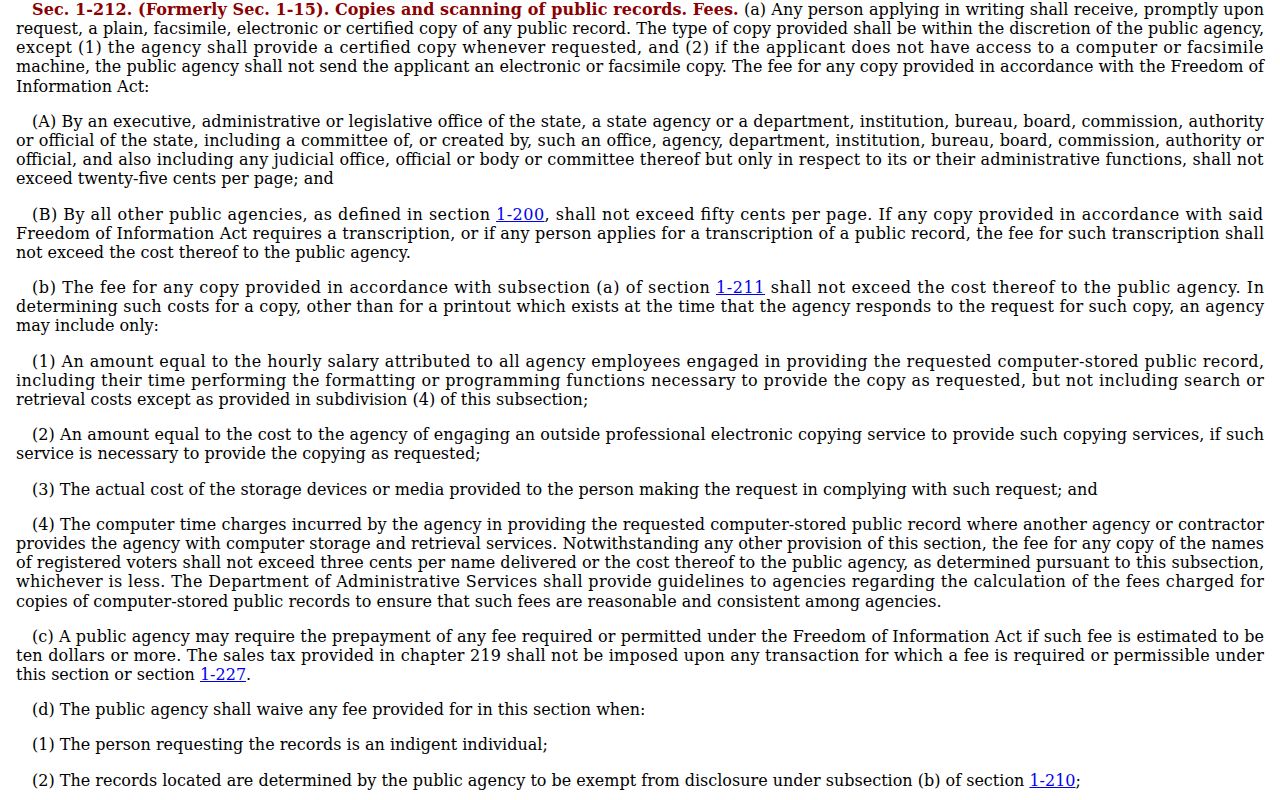
That statute supports fee questions for many public-agency requests, while Superior Court copies still need the Judicial Branch or clerk's current process.
Restricted Waterbury Court Records
Some Waterbury City court records are public only in part, or not public at all. Juvenile records are restricted under C.G.S. 46b-124. Youthful offender records are confidential under C.G.S. 54-76l. Criminal erasure is addressed by C.G.S. 54-142a, which can remove eligible dismissed, nolled, acquitted, pardoned, or otherwise erased matters from public access.
Family, juvenile, probate, and criminal files may also contain personal identifiers, financial account data, protected addresses, child information, mental health material, adoption records, or sealed filings. A docket may still show that a case exists while hiding the protected document or field. For sealed records, access usually requires a court order or a statute that permits review. For erased criminal matters, public agencies generally must treat the erased information differently from an ordinary public court record.
The confidentiality rule for juvenile court records is documented in Connecticut's juvenile-records statute.
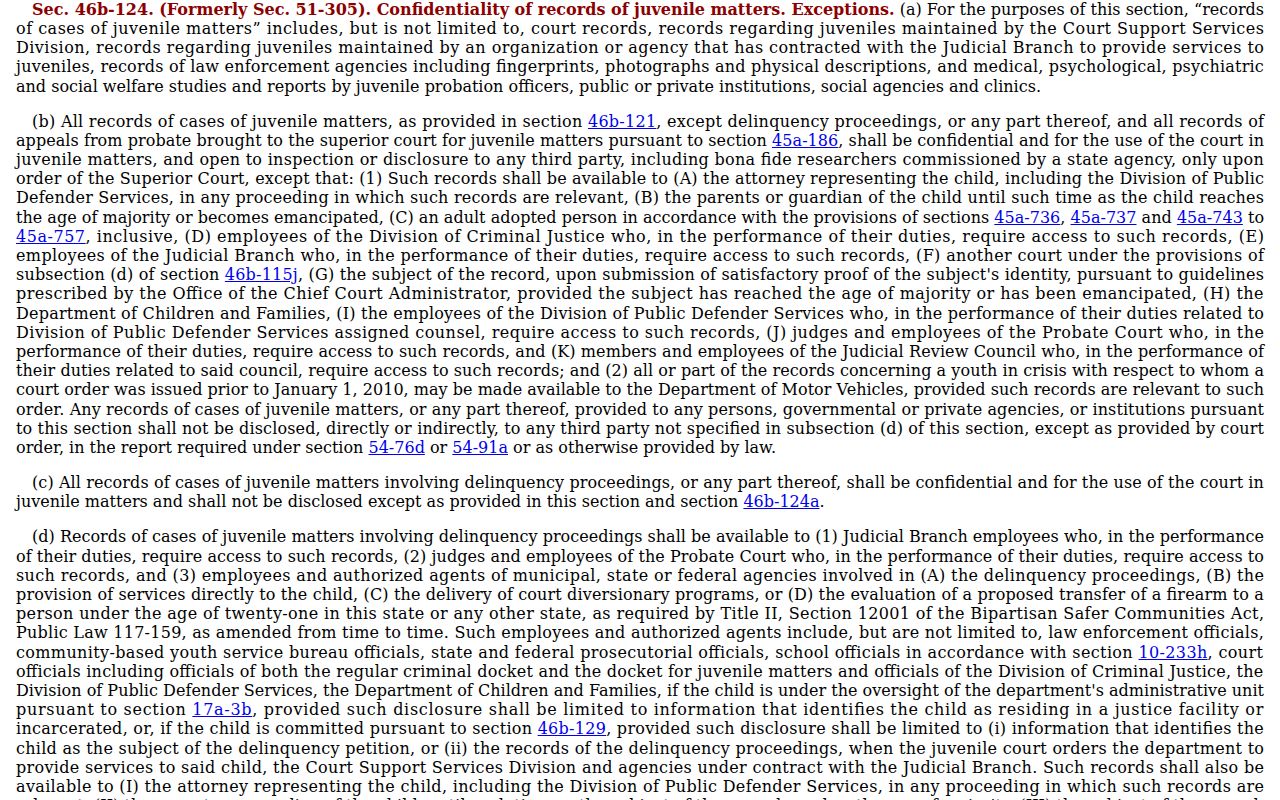
This restriction explains why a Waterbury juvenile matter should not be expected to appear like an adult public criminal or civil case.
Waterbury Court Record Requests
In-person requests work best when the searcher already has a docket number, party name, case type, and approximate filing date. Waterbury civil and family court records route through the Superior Court clerk at 300 Grand Street. Criminal and motor vehicle case records route through the Waterbury J.D. criminal and Geographical Area court operation at 400 Grand Street. City police records are separate from court case files, so requests for incident reports should go to the Police Records Division or city GovQA process.
Superior Court Clerk, Civil and Family
300 Grand Street
Waterbury, CT 06702
(203) 591-3300
Use for civil, family, and related Waterbury Judicial District records.
Superior Court Clerk, Criminal and GA #4
400 Grand Street
Waterbury, CT 06702
(203) 236-8100
Use for criminal, motor vehicle, arraignment, and GA #4 case records.